Classroom Activities
Every activity here needs nothing but a board and a class. Most work with forty students, and most can be shortened to five minutes.
Speaking activities
Find someone who
Write six statements on the board: Find someone who walked to school today. Find someone who has a younger brother. Students move and ask until they have a name for each.
Why it works: every student speaks, the question form is practised repeatedly, and it takes six minutes. Adapt the statements to the grammar you are teaching.
Two truths and a lie
Each student says three sentences about themselves; the class guesses which is false.
Why it works: it produces real questions and real listening, and students remember one another's sentences. Excellent for the past simple.
The one-minute talk
A topic on the board. Students speak to a partner for one minute without stopping. Then swap. Then repeat the same topic with a new partner for forty-five seconds.
Why it works: the repetition with less time is the whole point — the second telling is always more fluent, and students hear themselves improve within four minutes.
Describe and draw
One student describes a simple picture or diagram; the partner draws it without looking. Then compare.
Why it works: it forces precise use of position language, and the gap between the drawing and the original shows exactly where the description failed.
Silent line-up
Students arrange themselves in a line by birthday, or by distance travelled to school, without speaking English — then explain in English how they worked it out.
Why it works: it separates the task from the language, so the language comes afterwards, when they have something to say.
Writing activities
Sentence combining
Two short sentences on the board. Students write three different ways of joining them. Take answers; put the best on the board.
Why it works: it teaches complex sentence structure without a single grammatical term, and it works at every level in the same class.
The disappearing model
Write a model notice or paragraph on the board. Read it together. Rub out five words; the class reads it again, supplying them. Rub out ten more. Continue until the board is empty and they are reciting it.
Why it works: by the end the structure is internalised, and weak students who could not have written it can now produce it.
Paragraph relay
In fours: student 1 writes the topic sentence and passes the paper on; student 2 the supporting sentence; student 3 the example; student 4 the conclusion. Then read them out.
Why it works: it makes the parts of a paragraph visible, and the joins that do not work are instructive.
Correct the teacher
Write a short paragraph on the board containing six deliberate errors. Students find and correct them in pairs.
Why it works: students correct far more willingly than they self-correct, and the skill transfers. Use their own common errors.
Write the question
Give the answer; students write the question. Answer: For about three years. → How long have you lived here?
Why it works: question formation is the weakest area for most learners and is rarely practised in isolation.
Reading and vocabulary activities
Running dictation
A short text on the wall at the back. One student runs, reads, returns and dictates; the partner writes. Then swap.
Why it works: reading, memory, speaking, listening and writing in one activity, and the class is energised rather than restless.
Prediction from the title
Before reading, give only the title. Students write three things they expect the passage to contain. Then read and check.
Why it works: it gives students a reason to read, and reading with a purpose is dramatically more effective than reading to answer questions afterwards.
Word of the day, used
One word on the board each day. The rule: it must be used in class, correctly, by five different students before the lesson ends.
Why it works: the word gets used rather than copied, and students listen for one another's attempts.
Odd one out
Four words on the board; students decide which does not belong and justify it. Accept any answer that is defended.
Why it works: the justification is the language practice, and because several answers are defensible, weaker students can succeed.
Back to the board
One student sits with their back to the board. A word is written; the class describes it without saying it. The student guesses.
Why it works: it teaches the most valuable spoken skill there is — describing a word you do not have — and the whole class participates.
Making activities work in a class of forty
- Demonstrate; do not explain. Do one round yourself with a student in front of the class. Thirty seconds of demonstration beats two minutes of instruction.
- Set a time and keep to it. You have four minutes. Activities without a stated limit expand and lose their energy.
- Pairs, not groups, when space is tight. Pairs need no movement and double the amount of speaking.
- Always plan the ending. How will you stop it and what will you do with the results? An activity that ends in noise and nothing teaches that activities are not serious.
A book of ready-to-run lessons
Forty spoken English lessons for the primary classroom, each planned to fit one period and to need no special materials.
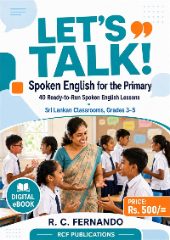 Let's Talk! Spoken English for the PrimarySee it in RCF Publications