Primary English
English for children who are still building it: the letters, the sounds, the first words, the first sentences, and the first whole page read without help.
Play the games
Six kinds of English game for Grades 1 to 5. Each one takes three to five minutes, works on a phone, and keeps your stars when you come back.
Primary Game Zone
Picture matching, memory pairs, quizzes, sorting, sentence building and missing words - one colourful set for each grade.
Who this section is for
Children roughly between Grade 1 and Grade 5, and the adults sitting beside them. Some of these pages are for the child to work through; others are for a parent or teacher to use with the child. Each page says which it is at the top.
The order is deliberate. Letters before words, words before sentences, sentences before paragraphs. A child who is rushed past a step usually has to come back to it later, and by then it is harder, because they have decided they are bad at English.
Ten minutes a day beats an hour on Sunday
Young children learn language in short, frequent bursts. Ten minutes every day will do more than one long session at the weekend, and it is far easier to keep up.
Stop while the child is still enjoying it. Ending a session one minute early is what makes them willing to start again tomorrow.
Choose a grade
Each grade follows the primary English syllabus. If you would rather browse by activity, the section below does that instead - both routes reach the same material.
Grade 1
Oral English through 16 themes, with an activity book and model papers.
Grade 2
Songs to sing along with, following the Activity Based Oral English themes.
Full Grade 2 resources in preparation.
Grade 3
Alphabet sounds, words of three or four letters, and sentences of up to five words.
Grade 4
Pronouns, numbers to 50, and writing with capital letters and full stops.
Grade 5
Three tenses, everyday texts, and writing accurate simple sentences.
Browse by skill
Picture Readers
Stories where a picture stands in for a word, Grades 3 to 6. Written below textbook level for children who find reading English hard.
Alphabet Practice
Letter shapes, letter sounds, capitals and small letters, and how to hold a pencil.
Primary Activities
Things to do with a child: no materials, little preparation, ten minutes each.
Poems
Traditional rhymes and verses written for this site, with what to do with each.
Short Reading Comprehensions
Short passages with questions, getting longer a little at a time.
Interactive Activities and Games
Activities that mark themselves and say why an answer was wrong.
Grade 5 Scholarship
The English-medium language work, practised honestly and without pressure.
The order we teach in
Nothing here is new or clever. It is the ordinary order, followed properly, which is rarer than it sounds.
The letter shapes
A child must be able to see the difference between b and d, and between capital and small letters, before spelling means anything.
The letter sounds
The sound a letter makes, not only its name. A child who knows only names cannot sound out a new word.
Blending sounds into words
c-a-t said slowly, then quickly, then as one word. This is the single step that turns a child into a reader.
Whole words by sight
The common words that do not sound out neatly - the, was, said, one - learnt as shapes.
Sentences
Capital letter, words in order, full stop. Read first, then written.
Short passages
Four or five sentences, then a question that cannot be answered without reading them.
About the poems on this site
- Children's poems are protected by copyright in the same way as any other writing.
- Only two kinds of verse appear here: traditional rhymes that are long out of copyright, and verses written for RCF English. Each poem says which it is.
- If your child's schoolbook has a poem in it, use the book. We cannot reproduce it here, and neither can anybody else without permission.
Where to go next
Interactive Learning
Activities across the whole site, for every level.
Teacher Resources
Lesson plans, worksheets and marking guidance.
O/L English
Where a child is heading after the primary years.
RCF Online Academy
Classes taught online by Rohana Fernando.
A book of spoken English lessons for the primary classroom
Forty ready-to-run lessons for teachers of the primary grades, each planned to fit a single period.
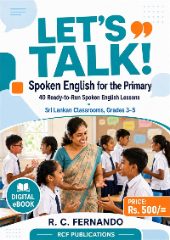 Let's Talk! Spoken English for the PrimarySee it in RCF Publications